
 admin
admin Potato Towers: How to Grow More Potatoes in Less Space
Potato Towers: How to Grow More Potatoes in Less Space
Growing Potatoes When Space Is Limited
Growing your own food is deeply satisfying—but for many gardeners, space is the biggest challenge. Traditional potato growing methods require wide rows, deep soil, and a lot of digging. That’s fine if you have a large garden, but what if you don’t?
This is where potato towers come in.
Potato towers are a vertical gardening method that allows you to grow a large amount of potatoes in a surprisingly small area. Whether you’re working with a tiny backyard, a patio, or a compact urban garden, this technique lets you turn vertical space into a productive food-growing system.
In this guide, you’ll learn exactly how potato towers work, how to build one step by step, which potato varieties perform best, and how to avoid common mistakes that reduce yield.
What Are Potato Towers?
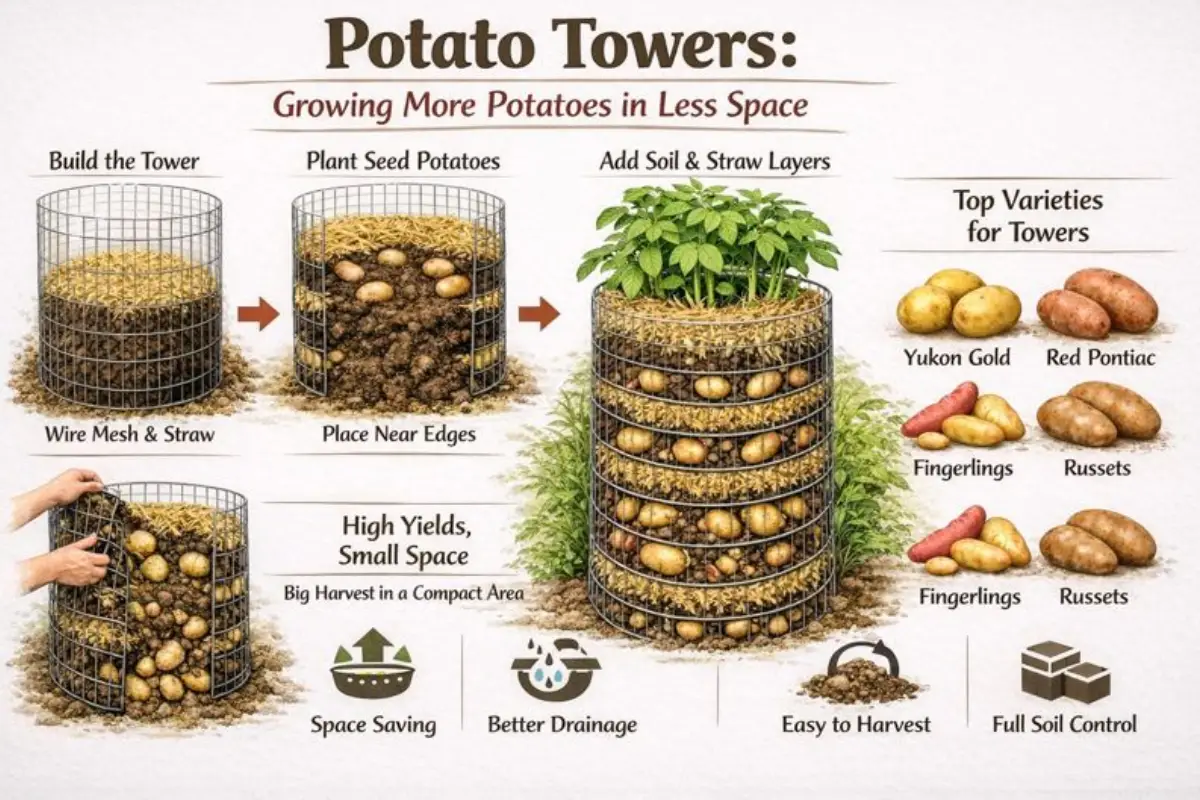
A potato tower is a vertical container—often cylindrical—designed to grow potatoes upward instead of outward. As the potato plant grows taller, soil and straw are added in layers, covering the stem and encouraging new potatoes to form at multiple levels.
This method mimics traditional “hilling” but does it vertically.
Common Potato Tower Materials
- Wire mesh or fencing
- Straw, hay, or dry leaves
- Loose soil mixed with compost
- Seed potatoes
The result is a compact structure that produces potatoes throughout its height rather than just underground.
Why Potato Towers Are So Effective
Potatoes grow along buried stems. Every time you cover part of the stem with soil, you create new opportunities for tubers to develop.
Main Benefits of Potato Towers
1. Space Efficiency
One tower can replace several feet of garden rows, making it ideal for:
- Small yards
- Raised-bed gardens
- Urban environments
2. Higher Yield Per Square Meter
Because potatoes grow vertically, you’re using space more efficiently than traditional methods.
3. Excellent Drainage
Straw and layered soil prevent waterlogging, which is a common cause of potato rot.
4. Easy Harvesting
Instead of digging, you simply open or tip the tower and collect clean potatoes.
5. Full Soil Control
You choose the soil quality, nutrients, and moisture level—no guessing.
Best Locations for a Potato Tower
Choosing the right spot makes a huge difference.
Sunlight Requirements
- Minimum 6–8 hours of direct sunlight daily
- More sun = stronger plants and larger tubers
Placement Tips
- Avoid low spots where water collects
- Keep towers away from strong wind
- Place near a water source for easy watering
Potato towers work well on soil, concrete, or gravel—as long as drainage is good.
Materials Needed to Build a Potato Tower
You don’t need expensive tools or advanced skills.
Basic Materials
- Wire mesh or fencing (galvanized preferred)
- Straw or dry leaves
- Compost-rich soil
- Seed potatoes
- Zip ties or wire
Optional Additions
- Landscape fabric lining
- Wooden pallet frame
- Drip irrigation hose
Step-by-Step: How to Build a Potato Tower
Step 1: Build the Structure
Form a cylindrical tower:
- Diameter: 60–90 cm (2–3 feet)
- Height: 90–120 cm (3–4 feet)
Secure the mesh tightly to prevent bulging.
Step 2: Prepare the Base Layer
- Add a thin straw layer for drainage
- Add 15–20 cm (6–8 inches) of loose soil
This layer anchors the plants.
Step 3: Plant the Seed Potatoes
Place seed potatoes near the edges with eyes facing outward.
Spacing:
- About 15 cm (6 inches) apart
- Usually 4–6 potatoes per layer
Cover with soil and straw.
Step 4: Build Layers as Plants Grow
When plants reach 20–25 cm (8–10 inches):
- Add more soil
- Add straw
- Leave top leaves exposed
Repeat until the tower is full.
Why Straw Is So Important
Straw isn’t just filler—it plays a crucial role.
Benefits of Straw Layers
- Improves drainage
- Prevents soil compaction
- Keeps potatoes clean
- Regulates moisture and temperature
Avoid using fresh grass clippings, which can rot and smell.
Best Potato Varieties for Towers
Not all potatoes perform equally in vertical systems.
Top Choices
- Yukon Gold – balanced growth, great flavor
- Red Pontiac – reliable and productive
- Fingerling Potatoes – compact and high-yield
- Russets – large yield, needs taller towers
Varieties to Avoid
- Very aggressive spreading types
- Potatoes bred strictly for field farming
Watering a Potato Tower Correctly
Potato towers dry out faster than ground soil.
Watering Tips
- Water deeply, not frequently
- Keep soil moist, never soggy
- Check moisture near the center
In hot weather, daily watering may be needed.
Fertilizing for Maximum Yield
Too much fertilizer can reduce potato production.
Best Approach
- Use compost-rich soil
- Add organic fertilizer once mid-season
- Avoid high-nitrogen products
Healthy foliage is good—but potatoes matter more.
Common Potato Tower Problems (And How to Fix Them)
Problem: Lots of Leaves, Few Potatoes
Cause: Too much nitrogen
Solution: Reduce fertilizer, increase potassium
Problem: Small or Misshapen Potatoes
Cause: Inconsistent watering
Solution: Maintain steady moisture
Problem: Rotting Tubers
Cause: Poor drainage
Solution: Add more straw, improve airflow
Problem: Tower Bulging
Cause: Loose structure
Solution: Reinforce with stakes or wire
When and How to Harvest Potatoes
Signs Potatoes Are Ready
- Plants flower or yellow
- Leaves begin to die back
Harvest Methods
- Partial Harvest: Open a side and remove mature potatoes
- Full Harvest: Tip the tower over and collect everything
This method prevents damaged or cut tubers.
How Much Can One Potato Tower Produce?
Yield depends on:
- Tower size
- Variety used
- Care quality
On average:
- 1 tower = 5–10 kg (11–22 lbs) of potatoes
That’s impressive for such a small footprint.
Potato Towers vs Traditional Potato Beds
| Feature | Potato Tower | Traditional Bed |
|---|---|---|
| Space usage | Minimal | Large |
| Soil control | Full | Limited |
| Harvest effort | Easy | Heavy digging |
| Drainage | Excellent | Soil-dependent |
Are Potato Towers Worth It for Beginners?
Yes—especially beginners.
Why Beginners Love Them
- Clear steps
- Fewer pests
- Less digging
- Easy to monitor
Mistakes are easier to fix than in-ground planting.
Can You Reuse a Potato Tower?
Absolutely.
End-of-Season Tips
- Compost old soil
- Clean wire mesh
- Store straw dry
- Rotate crops next season
Rotation prevents disease buildup.
Final Thoughts: Small Space, Serious Results
Potato towers prove that gardening isn’t about how much land you have—it’s about how smartly you use it. With basic materials and simple care, you can grow a surprising amount of food in a compact space.
If you want high yields, clean harvesting, and full control over your soil, potato towers are one of the most efficient methods available today.
0 Comment